Content:
Section 1: Five pillars of Islam
Section 2: 6 pillars of Iman (Belief)
Section 3: Haram/ Halal
Section 4: Major Sins
Section 5: Minor Sins
Section 6: Kalimaas
Section 7: Books/Lectures/ Movies
Section 8: Basic Vocabulary
Section 1: Five pillars of Islam
Courtesy of Muslimah's Homepage on Islam
Witnessing-Shahadah
To do this one must simply state publicly "Ashadu alla ilaha illa Allah, wa ashadu anna Muhammed ar-rasool Allah".
This means, "I bear witness that there is no God other than Allah, and I bear witness that Muhammed is His messanger."
It should be a genuine belief from
one's heart. The witnessing of the Oneness of Allah is the rejection of
any form of deity other than Allah, and the witnessing that Muhammad is
His Messenger is the acceptance of him being chosen by Allah to convey
His message of Islam to all humanity and to deliver it from the darkness
of ignorance into the light of belief in, and knowledge of, the Creator.
Prayer-Salat
In prayer, every muscle and bone of the body joins the soul and the mind in the worship and glory of Allah(swt).
Offering of prayers is obligatory upon every Muslim who is sane, mature and in the case of women free from menstruation and confinement due to child birth. some requirements must be met in oreder for the prayer to be valid. These include but are not limited to:
- Performing wudu - ritually cleaning the body clothes and ground used for prayer.
- Clothing - one must be covered in the manner according to his gender.
- Facing the Ka'ba (refered to as the Qibla)
- Intention - merely saying in your mind that you are attempting to pray and gain the benifits from it.
Prayers are required at least
five times a day. Other obligatory prayer include the Friday congregational
prayer, Eid prayers and the funeral prayer. Times of the five daily obligatory
prayers:
1.Fajr-Before sunrise.
2.Zuhr-After the sun begins to decline from its zenith.
3.Asr-Mid-afternoon.
4.Magrib-Just after sunset.
5.Isha-night.
In addition one is also encouraged
but not required to perform prayers during the day and night. Prayer should
be offered in its due time, unless there is a reasonable excuse. Delayed
obligatory prayers must be made up. In addition to the prescribed prayer,
a Muslim expresses gratitude to Godand appreciation of His favours and
asks for His mercy all the time. Especially at times of, childbirth, marriage,
going to or rising from bed, leaving and returning to his home, starting
a journey or entering a city, riding or driving, before or after eating
or drinking, harvesting, visiting graveyards and at time of distress and
sickness.
Charity-Zakah
Obligatory charity giving is an act of worship and spiritual investment. Zakah does not only purify the property of the contributor but also purifies his heart from selfishness and greed. It also purifies the heart of the recipient from envy and jealousy, from hatred and uneasiness and it fosters instead good-will and warm wishes for the contributors. It also frees society from welfare, distrust and coruption. Zakah is paid on the net balance after paying personal expenses, family expenses, due credits, taxes, etc. Taxes paid to government do not substitute for this religious duty. The contributor should not seek pride or fame but if disclosing his name and his contribution is likely to encourage others, it is acceptable to do so.
The recipients of Zakah are:
- the poor, the needy,
- the new Muslim converts,
- the Muslim prisoners of war (to
liberate them),
- Muslims in debt,
- employees appointed to collect
Zakah,
- Muslims in service of research
or study or propagation of Islam,
- wayfarers who are foreigners in
need of help.
Note that Zakah is obligatory. Muslims
can also go above and beyond what they pay as Zakah, in which case the
offering is strictly voluntary (blessing will come to those who wish for
his brother what he wishes for himself).
Fasting-Sawm
Fasting is abstaining completely
from eating, drinking, and intimate sexual contacts from the break of dawn
till sunset. It is a matchless Islamic institution which teaches man the
principle of sincere love to God, creative sense of hope, devotion,patience,
unselfishness, discipline, etc. Obligatory fasting is done once a year
for the period of the month of Ramadan. Fasting during this time
is obligatory on every muslim adult if he is mentally and physically fit
and not on a journey. Women are allowed to skip a fasting day due to menstruation,
and while nursing a baby.
Pilgrimage-Hajj
It is obligatory to make the pilgrimage to Mecca, at least once in a lifetime. Muslims from all walks of life, from every corner of the globe assemble in Mecca in response to the call of Allah. It is to commemorate the Divine rituals observed by the Prophet Abraham and his son Ishmael, who were the first pilgrims to the house of Allah on earth: the Ka'bah. It is also to remember the great assembly of the Day of Judgement when people will stand equal before Allah. Muslims go to Mecca to glorify Allah, not to worship a man. The visit to the tomb of Prophet Muhammad at Madena is highly recommended but not essential in making the Hajj valid and complete.Section 2: 6 pillars of Iman (Belief)
The Pillars of Iman (Faith)
by Trina LynneThe pillars of Iman are those things that are believed in, in Islam. Iman means faith. There are six (6) pillars of faith. These pillars consist of:
Belief in Allah
Of course the first pillar is the belief in the All-Powerful, Most Beneficent. Believing in Allah, above all else is the first and most important. Its not only belief in Allah alone but in the way He is described through the Qu'ran and the Prophet Muhammad. This includes all 99 names, which I will discuss in a later publication.
Belief in His Angels
The second pillar of iman is the belief in Allah's angels. The angels are messengers of Allah. They are not his children as some may think. They were created from light and were created, before human, for the purpose of worshipping Allah. They can also appear in the shape of a man if so ordered to do so. Some of the angels' names, that we know of, are Jibra'il, Mika'il, Israfil, and Malik. They have many jobs such as guardians, gatekeepers, and Trumpeters.

Belief in His Messengers
The third pillar is the belief in Allah's Messengers. I know of twenty-five (25) Prophets mentioned in the Qur'an. These Prophets are: Elishia, Job, David, Dhul-Kifl, Aron, Hud, Abraham, Enoch, Elias, Jesus, Isac, Ishmael, Lot, Moses, Noah, Salih, Shuaib, Solomon, Ezra, Jacob, John, Jonah, Joseph, Zachariya, Muhammad. It is said that there are numerous others leading up to 313. Muhammad is the last and final Prophet and there will be none after he. It is our duty as Muslims to send salaams(the Peace and Blessings of Allah) when mentioning the names of any of the Prophets.
Belief in His Books
The fourth pillar of iman is the belief in the books of Allah. Here it is the belief that at the time when these books were sent down they truly were a message from Allah. The only book left is the Qur'an in its entirety, because it is the last revelation Allah will send to us. There are four books known to man: The Torah sent with the Prophet Musa (Moses), the Psalms sent with the Prophet Dawud (David), the Gospel sent with Prophet Isa (Jesus) and the Qur'an sent with Prophet Muhammad. We as Muslims are to believe in all of these books and not just the Qur'an.
Belief in the Last Day
The fifth pillar of faith in the belief in the Last Day. This is the Day of accounting for all deeds; evil or good, big or small. In our lives we need to believe that all we do will have bearing on the Last Day. No one but Allah knows when this day will come, so it is up to us to live each day as if it was our last.
Belief in Al-Qadar (Pre-Ordainment)
The last pillar of iman is the belief in pre-ordainment. What this means is that everything in our lives is already written. It is our duty to know that whatever Allah wills will occur. Also He is the creator of everything including our deeds. Allah knows our past, present, and future. Our lives are set, but that does not mean that we strive any less toward perfection.
These pillars are the groundfloor of our faith as Muslims, considering the fact that the pillars of Islam are our foundation. Having the belief in all of this means that you understand Islam and in that understanding your faith is true.
Section 3: Haram/ Halal
Halal (Lawful) and Haram (Forbidden)
Halal is a Qur'anic term that means permitted, allowed, lawful, or legal. Its opposite is haram (forbidden, unlawful or illegal). Determining what is halal and haram is one matter that, prior to the advent of Islam, over which the peoples of the world were very far astray and utterly confused. Thus, they permitted many impure and harmful things and forbade many things that were good and pure.
They erred grievously, either going far to the right or the left. On the extreme right was India's ascetic Brahmanism and Christianity's self-denying monasticism. In addition, other religions were based on mortifying the flesh, abstaining from good food, and avoiding other enjoyments of life that God has provided for humanity. On the extreme left was Persia's Mazdak philosophy, which advocated absolute freedom and allowed people to take whatever they wanted and to do whatever they pleased. It even exhorted them to violate what is naturally held inviolable.
When Islam came, the errors, confusion, and deviations with respect to halal and haram were widespread. One of Islam's initial accomplishments was, therefore, to establish certain legal principles and measures for rectifying this situation. These principles were made the determining criteria on which defining halal and haram were based. Thus this vital aspect was determined according to the correct perspective, and the related rules were established on the basis of such principles as justice, morality, righteousness, and perfect goodness. As a result, the Muslim community occupied a position between the extreme deviations mentioned above and was described by God as a middle community, the best community that has ever been brought forth for humanity (3:110).
Basic Principles
- The first principle is that all that God has created and the benefits derived from them are for humanity's use are permissible. Nothing is haram except what is forbidden by a sound and explicit nass (i.e., either a Qur'anic verse or a clear, authentic, and explicit sunna [practice or saying] of the Prophet, upon him be peace and blessings. These are the two main sources of Islamic law.).
- In
Islam, the sphere of forbidden things is very small, while that of
permissible things is vast. In relation to acts of worship, the
principle is limitation: Nothing can be legislated in this regard except
what God Himself has legislated. But as far as living habits are
concerned, the principle is freedom, because nothing can be restricted
in this regard except what God Himself and the Messenger, as based upon
His Revelation, have forbidden. No rabbi, priest, king, or sultan has
the right to forbid something permanently to God's servants. The Qur'an
took to task the People of the Book (the Christians and Jews) for giving
their priests and rabbis the power to make things and actions lawful or
forbidden.
'Adiy ibn Hatim, who was a Christian before accepting Islam, once came to God's Messenger, upon him be peace and blessings. When he heard him reciting:
The Jews take their scholars (teachers of law), and the Christians take their monks, as well as the Messiah, son of Mary, for Lords beside God, whereas they were commanded to worship none but the One God. There is no deity but He. Glory be to Him, that He is infinitely exalted above that they associate partners with Him (9:31),
he said, "O Messenger of God, but they do not worship them." The Messenger replied, "Yes, but they forbid to the people what is halal and permit them what is haram, and the people obey them. This is indeed their worship of them." (Tirmidhi, "Tafsir," HN: 3292)
- One
of Islam's beauties is that it forbids only that which is unnecessary,
harmful, and discardable (useless and unwanted), while providing
alternatives that are better and give greater ease and comfort. For
example: God forbids seeking omens by drawing lots, but provides the
alternative of istikhara. Islam teaches that Muslims facing a problem
should consult other Muslims and seek God's guidance. Istikhara
means to ask for God's guidance in choosing between two conflicting
decisions. For this there is a salat and a du'a (a supplication for
guidance). He forbids usury but encourages profitable trade; forbids (to
men) the wearing of silk, but gives them the choice of wool, linen,
cotton, and so on; forbids adultery, fornication, and homosexuality, but
encourages lawful marriage; forbids intoxicating drinks but provides
other delicious drinks that are wholesome for the body and mind; and
forbids unclean food but provides alternative wholesome food.
Thus, when we survey all of Islam's injunctions, we find that if God limits His servants' choice in some matters, He provides them with a still wider range of more wholesome alternatives. Assuredly, God has no will to make peoples' lives difficult, narrow, and circumscribed; on the contrary; He wills ease, goodness, guidance, and mercy for them.
Another Islamic principle is that whatever leads to something that is forbidden is also forbidden. In this way, Islam intends to block all avenues leading to what is haram. For example, Islam forbids extramarital sex as well as anything that leads to it or makes it attractive (e.g., seductive clothing, private meetings and casual mixing between men and women, depicting nudity, pornography, obscene songs, and so on).
Just as Islam forbids whatever leads toward the haram, it forbids resorting to technical legalities in order to do what is haram by devious means and excuses. For example, God forbade the Jews to hunt on the Sabbath (Saturday). To get around this, they would dig ditches on Friday so that the fish would fall into them on Saturday and be caught on Sunday. Those who resort to rationalizations and excuses to justify their actions consider such practices permissible. However, Muslim jurists consider them haram, since God's purpose was to prevent them from hunting on the Sabbath, whether by direct or indirect means.
Renaming a haram thing or changing its form while retaining its essence is a devious tactic, since both actions are of no consequence as long as the thing and its essence remain unchanged. Thus, when some people invent new terms in order to deal in usury or to consume alcohol, the sin of dealing in usury and drinking remains. As we read in the Traditions: "A group of people will make peoples' intoxication halal by giving it other names" and: "A time will come when people will devour usury, calling it 'trade."
- In
all of its legislation and moral injunctions, Islam emphasizes the
nobility of feelings, loftiness of aims, and purity of intentions.
Indeed, in Islam, having a good intention transforms life's routine
matters and mundane affairs into acts of worship and devotion to God.
Accordingly, if one eats food with the intention of sustaining life and
strengthening one's body so that he or she can fulfill his or her
obligations to the Creator and other people, eating and drinking are
considered worship and devotion to the Al-mighty. If one enjoys sexual
intimacy with his or her spouse, desiring a child and seeking to keep
both spouses chaste, it is considered an act of worship that deserves a
reward in the Hereafter.
When Muslims perform a permissible action along with a good intention, the action becomes an act of worship. But the case of the haram is entirely different: It remains haram no matter how good the intention, how honorable the purpose, or how lofty the aim may be. Islam can never consent to employing a haram means to achieve a praiseworthy end. Indeed, it insists that both the aim and the means chosen to attain it must be honorable and pure. "The end justifies the means" has no place in Islam.
It is God's mercy to people that He did not leave them in ignorance concerning what is lawful and forbidden. Indeed, He has made these matters very clear. Accordingly, one may do what is lawful and must avoid what is forbidden insofar as one has the choice to do so. However, there is a gray area of doubt between the clearly halal and the clearly haram. Some people may not be able to decide whether a particular matter is permissible or forbidden, either because of doubtful evidence or of doubt concerning the text's applicability to the circumstance or matter in question. In such cases, Islam considers it an act of piety to avoid doing what is doubtful in order to stay clear of doing something haram.
In Islam, the haram has universal applicability, for that which is forbidden to a non-Arab cannot be permitted to an Arab, or that is restricted for a black person cannot be allowed to a white person. Islam contains no privileged classes or individuals who, in the name of religion, can do whatever they please according to their whims. No Muslim can forbid something to others but allow it for himself or herself, for God is the Lord of all and Islam is the guide for all. Whatever God has legislated through the religion He has sent for humanity is lawful for all people, and whatever He has forbidden is forbidden to all people until the Day of Resurrection.
Eating and Drinking
The following products are definitely lawful: Milk (from cows, sheep, and goats), honey, fish, plants that do not intoxicate, fresh or naturally frozen vegetables, fresh or dried fruits; legumes and nuts (e.g., peanuts, cashew nuts, hazel nuts, walnuts), and grains (e.g., wheat, rice, rye, barley, oats). Such animals as cows, sheep, goats, deer, geese, chickens, ducks, and game birds are lawful, but they must be sacrificed according to Islamic rites before being eaten.
Sacrificing
animals in the Islamic manner (zabiha) and following Islam's dietary
rules are excellent ways to avoid certain diseases. Sacrificing is done
to ensure the meat's quality and to avoid any microbial contamination.
Lawful animals must be offered in such a way that all of the blood is
drained from the animal's body.
The Islamic method of sacrificing an
animal is to cut its throat, so that the blood runs out and does not
congeal in the veins. Thus, animals that have been strangled, beaten to
death, or died in a fight or accident cannot be eaten. One who
sacrifices the animal must be a mature sane Muslim, who sacrifices it
while reciting Bismi'llah (In God's Name) with a sharp device and
without severing it. The animal must be completely dead before it is
skinned.
A product is considered haram if it has any contact with, or contains anything from:
- Pigs, dogs, donkeys, and carnivorous animals (e.g., bears and lions).
- Reptiles and insects that are considered ugly or filthy (e.g., worms, lice, flies, and cockroaches).
- Animals
killed by strangulation, a blow to the head (clubbing), a headlong
fall, natural causes (carrion), or being gored or attacked by another
animal. Fish are exempted from this class. When the Messenger was asked
about the sea, he replied: "Its water is pure and its dead are halal."
- All animals, except fish, that are not sacrificed according to Islamic rules.
- Alcohol,
harmful substances, and poisonous and intoxicating plants or drinks
(e.g., hashish, opium, and contemporary drugs, whether natural or
chemical).
- Animals with protruding canine teeth (e.g., monkeys, and cats, lions).
- Amphibians (e.g., frogs, crocodiles, and turtles).
- Animals slaughtered for worship of, or in the name of, that which is not God.
- Scorpions, centipedes, rats, and similar animals.
- Animals that are forbidden to be killed (e.g., bees).
Birds with talons (e.g., owls and eagles). - Any meat that has been cut off of a live animal.
- Blood.
- Animals won in a bet or a game of chance.
- Food additives whose raw materials are forbidden and produced through a process incompatible with Islam.
- Such impurities as dogs and pigs, alcohol, dead bodies not killed according to Islamic principles (except fish), blood, human and animal urine and waste matter, parts obtained from stillliving animals (except for wool, hair, horns, and so on), and the milk of animals that cannot be eaten (e.g., donkeys, cats, and pigs).
Medical Necessity
Jurists
differ over whether some of the forbidden food substances can be used
as medicine. Some do not classify medicine as a "compelling necessity"
like food based upon the following hadith: "Assuredly God did not
provide a cure for you in what He has forbidden to you." Others consider
the need for medicine equal to that of food, for both are necessary for
preserving life. However, they maintain that any medicine containing a
haram substance is permissible only under the following conditions: If
the patient's life is endangered if the medicine is not taken; if there
is no entirely halal alternative or substitute medication available; and
if the medication is prescribed by a Muslim physician who is both
knowledgeable and God-conscious.
Hunting and Game Animals
- For
game animals to be lawful, the hunter must be a Muslim or a member of
the People of the Book. A Muslim cannot hunt while in the state of
ihram.
- The
hunter should not hunt merely for sport, meaning that he or she kills
animals but has no intention to eat them or to otherwise benefit from
them.
- The
weapon should pierce the animal's body, making a wound, for death by
impact (e.g., hitting a deer with a car) does not make it halal.
- The hunter must say Bismi'llah when hurling or striking with the weapon, or dispatching the hunting animal.
- If a dog, a falcon, or a similar animal is used, it should be a trained animal and catch the game animal only for its owner.
- The
song's subject matter should not be against Islam's teachings. For
example, if the song praises wine and invites people to drink, singing
or listening to it is haram. It also must not stir up pessimism and
despair.
- Although
the subject matter may not be against Islamic teachings, the way of
singing (e.g., bodily movements that stir up lust or impulses to commit
haram acts) may render it haram.
- Islam
opposes excess and extravagance in anything, so it cannot tolerate
excessive involvement with entertainment. Too much time should not be
wasted in such activities.
- Each
individual is the best judge of oneself. If a certain type of singing
arouses one's passions, leads one toward sin, excites the animal
instincts, and dulls spirituality, one must avoid it so that he or she
will not cave into temptation.
- There
is unanimous agreement that if singing is done in conjunction with
haram activities like attending a drinking party, or if it is mixed with
obscenity and sin, it is haram.
Movies. Movies may be regarded as permissible if the following conditions are met:
- The
content must be free of sin and immorality – indeed, of anything that
is against Islamic beliefs, morals, and manners. Portrayals that excite
sexual desire or greed, glorify crime, or propagate deviant ideas, false
beliefs, and the like are not permissible, and Muslims cannot watch or
encourage them.
- Watching movies should not result in the neglect of religious obligations or worldly responsibilities.
- Physical
intermingling and free mixing among men and women in movie theatres
must be avoided in order to prevent sexual undertones and temptation.
- The Qur'an and the Hadith urge Muslims to engage in trade and commerce, and to travel in order to "seek God's bounty."
Forbidden Trades. Islam forbids all trade that involves injustice, cheating, making exorbitant profits, or promoting that which is haram. Examples of such trades are doing business in alcoholic beverages, intoxicants, drugs, pigs, idols, or anything whose consumption and use has been forbidden. Any related earnings are considered sinful.
Even if the trading is in entirely halal things, merchants must still adhere to many moral considerations, such as not lying and cheating, for those who cheat are considered to be outside the Islamic community; not tampering with the scales when weighing; not hoarding, lest they forfeit the protection of God and His Messenger; and not dealing in usury or interest (riba), for God has forbidden it.
The Prohibition of a Sale Involving Uncertainty. The Messenger forbade any kind of transaction that could lead to a quarrel or litigation due to some uncertainty.
Price Manipulation. In Islam, the market is to be free and allowed to respond to the natural laws of supply and demand. Unnecessary interference in the freedom of individuals is unjust. However, if any artificial forces (e.g., hoarding and price manipulation) interfere in the free market, public interest takes precedence over the individual's freedom. In such a situation, price control becomes permissible in order to meet society's needs and to protect it from greedy opportunists by thwarting their schemes. Researchers have concluded that, depending upon the nature of the circumstances, price controls may be either unjust and forbidden or just and permissible, depending upon the relevant circumstances.
Hoarding. Freedom for individual and natural competition in the marketplace is guaranteed by Islam. Nevertheless, it severely condemns those who, driven by ambition and greed, accumulate wealth at the expense of others and become rich by manipulating the price of food and other necessities.
Interfering in the Free Market. The Messenger forbade another practice related to hoarding: allowing a person in the town to sell on behalf of a person from the desert. Scholars have explained this as follows: A stranger would bring some goods to be sold in town at the current market price. A townsman would approach him, saying: "Leave them with me for a while. I will sell them for you when the price is better." If the stranger had sold his own goods, the price would have been lower, the people would have benefited, and he would have made a reasonable profit.
Brokerage. With the exception of such unlawful cases as mentioned above, brokerage is permissible, since it is a kind of mediation and connection between the buyer and the seller, which in many cases facilitates a profitable transaction for at least one of them or for both. In modern times, brokers have become far more necessary than before due to the complexities of trade and commerce, which involve all types of exports and imports, and wholesale and retail sales and purchases. Brokers play an important role in keeping things moving. There is nothing wrong, therefore, if they charge a commission for their services. The commission may be a fixed amount, proportional to the volume of sales, or whatever is agreed upon among the parties involved.
Exploitation and Fraud. In order to prevent the market's manipulation, the Messenger forbade najash. Ibn 'Umar explained that najash signifies someone's bidding for an item in excess of its price without having any intention of actually buying it, but merely in order to induce others to bid still higher. Many times this is prearranged for the purpose of deceiving others.
"He Who Deceives Us Is Not of Us." Islam prohibits every type of fraud and deception, whether in buying and selling or in any other matter between people. In all situations, Muslims must be honest and truthful, holding their faith to be dearer than any worldly gain.
Frequent Swearing. The sin of deceiving becomes greater when a seller supports it by swearing in God's name that something is true. God's Messenger told merchants to avoid swearing in general and, in particular, in support of a lie: "Swearing produces a ready sale but blots out the blessing."
He disapproved of frequent swearing in business transactions because it is probably done to deceive people, and because it reduces respect for God's Name.Withholding Full Measure. One way of defrauding customers is to measure or weigh inaccurately. The Qur'an orders full measure and full weight (6:52) and severely warns against any fraud in this aspect of business transactions:
Woe to those that deal in fraud, those who, when they have to receive by measure from people, exact full measure, but when they have to give by measure or weight to people, give less than (what is) due. Do they not think that they will be called to account? On a Mighty Day – A Day when (all) humanity will stand before the Lord of the Worlds? (83:1-6)
Buying Stolen Property. In order to combat crime and to confine criminals within a very narrow sphere of activity, Islam has forbidden Muslims to buy any article that they know to be usurped, stolen, or taken unjustly from its owner. Anyone who does so abets the usurper, the thief, or the one committing injustice.
Interest. Islam permits an increase in capital through trade. At the same time, it blocks the way for anyone who tries to increase his or her capital through lending on usury or interest (riba), whether at a low or a high rate.
Sale for Deferred Payment (Credit). While it is best to buy an article with cash, it is also permissible to buy on credit by mutual consent. Some jurists opine that if the seller increases his or her price and if the buyer asks for deferred payments, as is common in installment buying, the price differential due to the time delay resembles interest, which is likewise a price for time. Accordingly, they declare such sales to be haram. However, most scholars permit it because there is, on the whole, no resemblance to interest in such a transaction, since the seller is free to increase the price as he or she considers proper, as long as it does not cause blatant exploitation or clear injustice. If it does, it becomes haram. In order for such trade to be lawful, there should be mutual consent and the amount and the duration should be fixed and known to both sides.
Bribery. Taking a bribe is one way of consuming someone else's wealth wrongfully. A bribe refers to any kind of property offered to a judge or public servant in order to obtain a favorable decision favor of oneself or against a rival, to expedite one's own affair, or to delay any competition, and so on.
Wasteful Spending. Just as the wealth of others is sacred and any violation of it, whether secret or open, is forbidden, a person's wealth is sacred with respect to oneself. Thus, one should not waste it by extravagant or other wasteful spending.
Salaried Employment. Muslims are free to seek employment with a government, an organization, or an individual, as long as they can do their job satisfactorily and carry out their duties. However, they cannot seek a job for which they are unfit, especially if the job carries judicial or executive authority.
Forbidden Types of Employment. Muslims cannot take jobs that are injurious to the cause of Islam or harm Muslims. Accordingly, they cannot work for companies that manufacture haram items. Similarly, any service rendered in support of injustice or in promoting what is haram is itself haram. For example, Muslims cannot work in organizations that deal with interest, in bars or liquor shops, nightclubs, and the like.
A General Rule in Earning a Living. When it comes to making a living, Islam differentiates between lawful and unlawful methods. One of the rules is that any transaction in which one person's gain results in another's loss is unlawful, while any transaction that is fair and beneficial to all the parties concerned, and that is transacted by mutual consent is, lawful.
The verses:
O you who believe, do not devour one another's wealth in legally nonvalid, wrongful ways, except it be a trade by mutual consent; and do not cause your own and community's perishing. (Do not forget that) God has deep, special compassion (toward you as believers). Whoever acts wrongfully through enmity (toward others) and by way of deliberate transgression and wronging (both himself and others), We shall surely land him in a Fire to roast there. That indeed is quite easy for God (4:29-30),
lay down two conditions for a transaction: mutual consent of the parties involved, and the benefit to one party should not be a loss to the other.
- elations among the members of an Islamic
society are based upon two fundamental principles: awareness of the
strong bond of brotherhood and sisterhood that links one individual to
another, and protecting the individual's rights and the sanctity of his
or her life, honor, and property, as guaranteed by Islam. Any words,
deeds, or behavior that contravene or threaten these two principles are
forbidden, the degree of prohibition depending upon the magnitude of
material or moral injury that might result from it.
Severing Ties with a Fellow Muslim. It is haram for Muslims to shun, break ties, or turn away from a fellow Muslim. If two Muslims quarrel with each other, they may be allowed a cooling-off period of 3 days at the most, after which they must seek reconciliation and peace, overcoming their pride, anger, and hatred.
Settling Disputes. While it is incumbent upon disputants to settle their differences in an Islamic fashion, the Muslim community also has a responsibility in this regard. As it is based upon mutual caring and cooperation, it cannot stand by passively and watch its members dispute and quarrel with each other, and thereby permit the conflict to grow larger. Those who command respect and authority in the community are obliged to come forward to set things right with absolute impartiality and without allowing themselves to become emotionally involved with either side.
"Let Not Some People Mock Other People." In 49:10-12, God prescribes several things related to preserving Muslim brotherhood and sisterhood and what this implies with regard to that which people consider sacred. The first of these is the prohibition of mocking, deriding, and scoffing at others.
"Do Not Slander." The second prohibition is against lamz, which literally means "piercing and stabbing." Here it is used to mean finding faults, as the person who finds faults in others is doing something similar to piercing them with a sword or stabbing them with a dagger – and perhaps the wound inflicted by the tongue is more lasting. The form of prohibition expressed in 49:11 (Do not slander yourselves) is very subtle, for it means not to slander each other. This meaning is derived from the Qur'an's viewing the Muslim community as one body in its mutual concerns and responsibilities, so that whoever slanders a fellow Muslim in effect slanders himself or herself.
Suspicion. Islam seeks to establish its society on a clearn conscience and mutual trust, not on doubt, suspicion, accusation, and mistrust. Hence it mentions the fourth prohibition designed to safeguard what people hold sacred: O you who believe, avoid (indulging in) much suspicion. Truly some suspicion is a sin (49:12).
Sinful suspicion is defined as ascribing evil motives to others. Muslims cannot impute such motives to fellow Muslims without justification and clear evidence. Given that the basic assumption that people are innocent, mere suspicion should not be allowed to cause an innocent person to be accused.
Spying. Mistrust of others produces evil thoughts in the mind, while outwardly it leads a person toward spying. But since Islam establishes its society upon inner and outer purity, just as spying follows suspicion, the prohibition of spying comes immediately after that of suspicion. Prying into other peoples' private affairs and spying on their secrets is not permitted, even if they are engaged in sin, as long as they do it privately.
Backbiting. The sixth evil forbidden in the verses cited above is backbiting (ghiyba): And do not ... backbite one another (49:12). The verse likens it to eating of one's dead brother's (sister's) flesh. The Messenger, upon him be peace and blessings, wanted to drive home the meaning of backbiting to his Companions through questions and answers. He asked them: "Do you know what backbiting is?" They replied: "God and His Messenger know best." He said: "It is saying something about your brother (sister) which he (she) would dislike." Someone asked: "What if I say something about my brother (sister) that is true?" The Messenger replied: "If what you say of him (her) is true, it is backbiting; if it is not true, you have slandered him (her)." (Muslim, "Birr," 70; ABu Dawud, "Adab," 40)
Spreading Gossip. Another evil, which usually accompanies backbiting and is strictly forbidden by Islam, is gossiping. This is defined as passing on to others what you hear from someone in such a way that will cause dissension among people, sour their relationships, or increase already-existing bitterness between them.
The Sacredness of Honor. Islamic teachings safeguard human dignity and honor, and, in fact, regard them as inviolable and sacred. Once while looking at the Ka'ba, 'Abdullah ibn 'Umar remarked: "How great and sacred you are! But the sanctity of a believer is greater than yours." A Muslim's sanctity includes the sanctity of his or her life, honor, and property.The Sacredness of Life. Islam has made human life sacred and has safeguarded its preservation. According to its teachings, aggression against human life is one of the greatest sins, second only to denying God. The Qur'an regards killing a person unjustly as equivalent to killing all people (5:22). Since the human race constitutes a single family, an offense against one member is an offense against all of humanity. The crime is more serious if the killed person was a believer in God:
And for the one who kills a believer intentionally, his recompense is Hell, to abide therein. And the wrath of God is upon him and His curse, and a tremendous punishment has been prepared for him. (4:93)
The Messenger, upon him be peace and blessings, said: "The passing away of the world would mean less to God than the murder of a Muslim" and: "God may forgive every sin, except for one who dies as an idolater (and an unbeliever) or who kills a believer intentionally." (Nasa'i, "Tahrim," 1:2) On the basis of these verses and Traditions, Ibn 'Abbas deduced that God will not accept any repentance done by the murderer.
The Sanctity of the Lives of Allies and Non-Muslim Residents. Thus far we have quoted texts that warn Muslims against killing or fighting fellow Muslims. But let no one think that the life of a non-Muslim is not safe in a Muslim society, for God has declared the life of every person to be sacred, and He has safeguarded it.
This applies as long as the non-Muslims do not fight the Muslims. If they fight the Muslims, the Muslims can fight them in retaliation for their deeds. However, if the non-Muslims have a treaty with the Muslims or are dhimmis (non-Muslim residents of an Islamic state), their life is sacred and the Muslims cannot attack them.Suicide. Whatever applies to murder also applies to suicide. Whoever takes his or her own life, regardless of the method used, has unjustly taken a life that God has made sacred. Since people did not create themselves, not even one single cell, their life does not belong to them but is a trust given to them by God, the All-Merciful. They are not allowed to diminish it, let alone to harm or destroy it.
Islam requires Muslims to be resolute in facing hardships. They are not permitted to give up and run away from life's vicissitudes when a tragedy befalls them or some of their hopes are dashed. Indeed, they are created to strive, not to sit idle; for combat, not for escape. Their faith and character do not permit them to run away from the battlefield of life, and they possess a weapon that never fails and ammunition that is never exhausted: the weapon of unshakable faith and the ammunition of moral steadfastness.
The Sanctity of Property. Muslims are permitted to earn as much as they desire, as long as they do so through lawful means and increase their wealth through lawful investments, and pay the due on it such as zakat. However, Islam warns against attachment to wealth and the world and leading a luxurious, dissipated life, and exhorts believers to spend in God's way for the needy and God's cause.
Since Islam sanctions the right to personal property, it protects it, through moral exhortation and legislation, from robbery, theft, and fraud. The Messenger mentioned its sanctity in the same sentence with the sanctity of life and honor, and considered stealing as contradictory to faith: "A thief is not a believer while he (she) is engaged in stealing" (Bukhari, "Ashriba," 1; Muslim, "Iman," 24) and: "It is haram for a Muslim to take (so much as) a stick without its owner's consent."
Racial and Color Discrimination. There is no special distinction for people with a certain skin color or who belong to a particular "race" of humanity. Muslims cannot be a partisan of one race against another, and of one people against another.
- Islam's universal mercy embraces not only
human beings, whether believers, People of the Book, or non-Muslims, but
all other living creatures. Accordingly, Islam prohibits cruelty to
animals. Thirteen centuries before any societies for the prevention of
cruelty to animals were established, Islam made kindness to animals a
part of its faith, and cruelty to them a sufficient reason for a person
to be thrown into the Fire.
God's Messenger, upon him be peace and blessings, once related to his Companions that a prostitute found a dog panting with thirst. She descended into a well, filled her shoes with water, and gave it to the dog. She continued to do so until the dog's thirst was quenched. The Messenger said: "Then God was pleased with her, forgave her sins, and led her to the way of Paradise." (Bukhari, "Anbiya," 54; Muslim, "Salam," 153) He also mentioned a woman who left a cat without food and drink to die; she was led to the way of Hell.
Respect for God's living creatures reached such an extent that when the Messenger saw a donkey with a branded face, he denounced such a practice: "I would brand an animal only on the part of its body farthest from its face." (Canan, ibid., 6:306) When Ibn 'Umar saw some people practicing archery using a hen as a target, he said: "The Messenger, upon him be peace and blessings, cursed anyone who made a living thing into a target." Ibn 'Abbas said: "The Messenger forbade making animals fight each other, since people would goad animals into fighting each other until one of them was pecked or gored to death, or close to it." He also reported that the Messenger strongly condemned the castration of animals.
As regards slaughtering animals, Islam insists that it be done in the way that is least painful to the animal and that the knife be sharpened – but not in front of the animal. Islam also prohibits the slaughtering of one animal in front of another.
- Sin is committing something that God and
His Messenger have forbidden and not doing what they ordered to do.
Since a believer's heart and conscience are sensitive to sin and
obedience to God, God's Messenger said: "Righteousness is good morality,
and sin is that which causes discomfort (or pinches) within your soul
and which you dislike people to become informed of." (Tirmidhi, "Zuhd,"
52) In other words, sin is what Muslims try to abstain from at all
costs.
The Major Sins (al-Kaba'ir)
The major sins are those acts that God Has forbidden and threatened to punish severely if they are committed. God wills that they be avoided:
If you avoid the major (part) of what you have been forbidden (to do), We will cancel out for you your (other) evil deeds and will admit you (to Paradise) with a noble entry. (4:31)
Scholars differ in this regard. Some say there are seven major sins, and support themselves with the following hadith: "Avoid the seven noxious things" – and after having said this, the Messenger mentioned them: "Associating anything with God as a partner, magic, killing one whom God has declared inviolate without a just case, consuming an orphan's property, devouring usury, turning back when the army advances, and slandering chaste women who are believers but indiscreet."
However, this hadith does not limit the major sins only to those mentioned. Rather, it points to the type of sins that fall into the category of "major" without excluding others, such as violating the parents' rights, adultery and fornication, consuming alcohol, gambling, and theft, all of which are also included in this category.
- Unbelief in any of the essentials requiring belief
- Hypocrisy
- Neglecting any pillar of Islam (i.e., the prescribed prayers, paying zakat, fasting Ramadan, and Hajj)
- Violating the parents' rights
- Murder
- Practicing magic
- Adultery, fornication, and homosexuality
- Theft and usurpation
- Consuming alcohol
- Gambling
- Dealing with usury and interest
- Slandering innocent people, especially chaste women
- Fleeing the battlefield
- Wrongfully consuming an orphan's property
- Lying
- Backbiting
- Gossiping
- Mocking others
- Spying and ill-suspicion
- Abandoning relatives
- Wrongdoing and injustice
- Fraud and cheating
- Violating other people's rights
- Pride and arrogance
- Bearing false witness and taking a false oath
- Oppression
- Consuming wealth acquired unlawfully
- Giving short weight or measure
- Committing suicide
- Giving and accepting bribes
- Showingoff
- Learning about Islam for the sake of this world
- Betraying a trust
- Recounting favors
- Listening to private conversations
- Breaking one's promise
- Fortune-telling and believing in fortune-tellers
- Making idols and engaging in idolatrous practices
- Trading in unlawful things
- Displaying overbearing conduct toward one's spouse, servant, children, weak people, and animals
- Offending neighbors
- Offending and abusing Muslims
- Wearing silk and gold (men only)
- Sacrificing an animal in the name of that which is not God
- Knowingly ascribing one's paternity to one who is not his or her real father.
Muslims must try not to commit any sins. Moreover, when they do so, they must repent immediately and seek God's forgiveness. Scholars say that any sin, no matter how small, is great so long as it is committed with ease and indifference, without repentance, and without seeking God's forgiveness, while any major sin, no matter how great, is not great so long as it is avoided as much as possible and the one who commits it repents and seeks God's forgiveness.
Section 4: Major Sins in Islam
The Major Sins
--Al-Kaba'r--
The major sins are those acts which have been forbidden by Allah in the Quran and by His Messenger (SAW) in the Sunnah (practise of the Prophet), and which have been made clear by the actions of of the first righteous generation of Muslims, the Companions of the Prophet (SAW).Allah Most High says in His Glorious Book:
If you avoid the major (part) of what you have been forbidden (to do), We will cancel out for you your (other) evil deeds and will admit you (to Paradise) with a noble entry. (al-Nisa 4:31)Thus by this verse, Allah Most High has guaranteed the Garden of Paradise to those who avoid the major sins. And Allah Most High also says:Those who avoid the greatest of sins and indecencies, and forgive when they are angry (al-Shra 42:37) Those who avoid the greatest sins and indecencies, except for oversights, (will find that) surely your Lord is ample in forgiveness. (Al-Najm 53:32)The Messenger of Allah (SAW) said: "The five [daily] prayers, Friday to Friday, and Ramadan to Ramadan make atonement for what has happenned since the previous one when major sins have been avoided." It is therefore very important to determine exactly what the greatest vices, technically called "the major sins" (Kaba'ir), are, in order that Muslims should avoid them.There is some difference of opinion among scholars in this regard. Some say these major sins are seven, and in support of their position they quote the tradition: "Avoid the seven noxious things"- and after having said this, the propeht (SAW) mentioned them: "associating anything with Allah; magic; killing one whom Allah has declared inviolate without a just case, consuming the property of an orphan, devouring usury, turning back when the army advances, and slandering chaste women who are believers but indiscreet." (Bukhari and Muslim)
'Abdullah ibn 'Abbas said: "Seventy is closer to their number than seven," and indeed that is correct. The above tradition does not limit the major sins to those mentioned in it. Rather, it points to the type of sins which fall into the category of "major." These include those crimes which call for a prescribed punishment (HADD; plural, HUDUD), such as theft, fornication or adultery (ZINA), and murder; those prohibited acts for which a warning of a severe punishment in the Next is given in the Qur'an or the tradition; and also those deeds which are cursed by our Prophet (SAW). These are all major sins.
Of course, there is a gradation among them, since some are more serious than others. We see that the Prophet (SAW) has included SHIRK (associating someone or something with Allah) among them, and from the text of the Qur'an we know that a person who commits SHIRK will not his sin be forgiven and will remain in Hell forever.
Allah Most High says: Surely, Allah does not forgive associating anything with Him, and He forgives whatever is other than that to whomever He wills. (al-Nisa 4:48 and 116)
01. Associating anything with Allah
02. Murder
03. Practising magic
04. Not Praying
05. Not paying Zakat
06. Not fasting on a Day of Ramadan without excuse
07. Not performing Hajj, while being able to do so
08. Disrespect to parents
09. Abandoning relatives
10. Fornication and Adultery
11. Homosexuality(sodomy)
12. Interest(Riba)
13. Wrongfully consuming the property of an orphan
14. Lying about Allah and His Messenger
15. Running away from the battlefield
16. A leader's deceiving his people and being unjust to them
17. Pride and arrogance
18. Bearing false witness
19. Drinking Khamr (wine)
20. Gambling
21. Slandering chaste women
22. Stealing from the spoils of war
23. Stealing
24. Highway Robbery
25. Taking false oath
26. Oppression
27. Illegal gain
28. Consuming wealth acquired unlawfully
29. Committing suicide
30. Frequent lying
31. Judging unjustly
32. Giving and Accepting bribes
33. Woman's imitating man and man's imitating woman
34. Being cuckold
35. Marrying a divorced woman in order to make her lawful for the husband
36. Not protecting oneself from urine
37. Showing-off
38. Learning knowledge of the religion for the sake of this world and concealing that knowledge
39. Bertrayal of trust
40. Recounting favours
41. Denying Allah's Decree
42. Listening (to) people's private conversations
43. Carrying tales
44. Cursing
45. Breaking contracts
46. Believing in fortune-tellers and astrologers
47. A woman's bad conduct towards her husband
48. Making statues and pictures
49. Lamenting, wailing, tearing the clothing, and doing other things of this sort when an affliction befalls
50. Treating others unjustly
51. Overbearing conduct toward the wife, the servant, the weak, and animals
52. Offending one's neighbour
53. Offending and abusing Muslims
54. Offending people and having an arrogant attitude toward them
55. Trailing one's garment in pride
56. Men's wearing silk and gold
57. A slave's running away from his master
58. Slaughtering an animal which has been dedicated to anyone other than Allah
59. To knowingly ascribe one's paternity to a father other than one's own
60. Arguing and disputing violently
61. Witholding excess water
62. Giving short weight or measure
63. Feeling secure from Allah's Plan
64. Offending Allah's righteous friends
65. Not praying in congregation but praying alone without an excuse
66. Persistently missing Friday Prayers without any excuse
67. Unsurping the rights of the heir through bequests
68. Deceiving and plotting evil
69. Spying for the enemy of the Muslims
70. Cursing or insulting any of the Companiions of Allah's Messenger
Section 5: Minor Sins in Islam
Minor Islamic Sins
One may also make minor violations; these have not been given a specific punishment in the Qur’an. That is not to say such actions are insignificant; rather, their effect is on a smaller scale than those mentioned previously. Examples of minor sins in Islam include bragging, flirting, lying, and swearing.These actions, taken individually, do not constitute a breakdown in society or a severe violation of others’ rights. However, they are personality faults and if one persists in such behavior, it could rise to a higher level.
The Qur’an describes a people whose “hearts have been sealed by the sins they have accumulated” (Qur’an 83:14). The Prophet Muhammad explained this verse by saying that when a person sins even once, it is like a black dot is placed on his heart. When he sincerely repents, the dot is erased. However, if he persists and continues in the sin, the dot will expand until it covers his entire heart.
When this happens, the person ceases to recognize the difference between good and evil. Therefore it was the Prophet Muhammad’s advice to seek forgiveness from God for every mistake and counter it with increased worship and good deeds.
Section 6: Kalimaas
The 6 Kalimas
http://www.geocities.com/mutmainaa/
|
The 6 (six) Kalimas are recorded in various books of knowledge, and are recited (and remembered) by people across the globe. First KalimaThe Word of Purity (Tayyabah) La ilaha ill Allah Muhammadur-Rasul Allah (There is no God but Allah Muhammad is the Messenger of Allah) To Listen click here.
Second KalimaThe word of Testimony (Shahaadat) Ash-hadu an-La illaha ill Allahu, Wahdahu La Sharika lah, wa ash-Hadu anna Muhammadan 'abduhu wa Rasoolu To Listen click here.
Third KalimaThe word of Glorification (Tumjeed) Subhan
Allahu, wal Hamdu lillahi, wa la illaha ilAllahu, wallahu Akbar. wa La
hawla wa la quwwata illa billah-al 'alii-al 'adheem
To Listen click here.
Fourth KalimaThe word of Unity (Tauhid) لا الهَ اِلَّا اللّهُ وَحْدَهُ لا شَرِيْكَ لَهْ، لَهُ الْمُلْكُ وَ لَهُ
الْحَمْدُ يُحْى وَ يُمِيْتُ وَ هُوَحَىُّ لَّا يَمُوْتُ اَبَدًا اَبَدًا ط
ذُو الْجَلَالِ وَ الْاِكْرَامِ
ط
بِيَدِهِ
الْخَيْرُ ط
وَهُوَ عَلى كُلِّ شَئ ٍ قَدِيْرٌ
ط
La
ilaha illAllahu Wahdahu La Shareeka lahu, lahulmulk, wa lahulhamd,
yuhyee wa yumeet, wa huwa hayy la yumoot abadan abada Dhul Jalaali waal
Ikram beyadihi alkhayr, wa huwa 'ala kulli Shay'in Qadeer
(There is) none worthy of worship except Allah. He is only One. (There is) no partners for Him. For Him (is) the Kingdom. And for Him (is) the Praise. He gives life and acuses death. And He (is) Alive. He will not die, never, ever. Possessor of Majesty and Reverence. In His hand (is) the goodness. And He (is) the goodness. And He (is) on everything powerful.) To Listen click here.
Fifth KalimaThe word of Penitence (Astaghfar) اسْتَغْفِرُ اللّهَ رَبِّىْ مِنْ كُلِّ ذَنْبٍ اَذْنَبْتُه عَمَدًا اَوْ
خَطَاً سِرًّا اَوْ عَلَانِيَةً وَاَتُوْبُ اِلَيْهِ مِنْ الذَّنْبِ الَّذِىْ
اَعْلَمُ وَ مِنْ الذَّنْبِ الَّذِىْ لا اَعْلَمُ اِنَّكَ اَنْتَ عَلَّامُ
الغُيُبِ وَ سَتَّارُ الْعُيُوْبِ و َغَفَّارُ الذُّنُوْبِ
وَ لا حَوْلَ وَلا قُوَّةَ اِلَّا بِاللّهِ
الْعَلِىِّ العَظِيْم
Astaghfirullaha Rabbi min kulli dhanbin adhnabtahu amadan aw khata'an, sirran aw alaniyatan, wa atubuhu ilayhi min adh-dhanb illadhi a'lamu, wa min adh-dhanb illadhi la a'lamu, innaka anta allamal ghuyub, wa sattar ul'uyoubi, wa ghaffarudh dhunub, wa la hawla wa la quwwatta illa billahil 'aliy-al 'adheem
(I seek forgiveness from Allah, my Lord, from every sin I committed knowingly or unknowingly, secretly or openly, and I turn towards Him from the sin that I know and from the sin that I do not know. Certainly You, You (are) the knower of the hidden things and the Concealer (of) the mistakes and the Forgiver (of) the sins. And (there is) no power and no strength except from Allah, the Most High, the Most Great) To Listen click here.
Sixth KalimaThe words of rejecting disbelief (Rud-A-Kuffer) 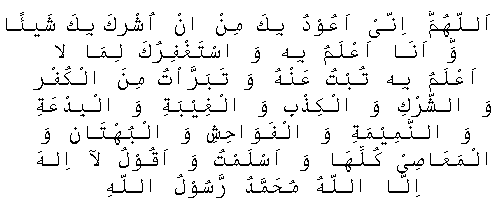
Allahumma innii a'udhu bika min an ushrika bika shai-anw- wa ana a'lamu bihii. Was tagh fi ru ka limaa laa alamu bihee. Tubtu anhu wa tabarra-tu min al-kufri wash-shirki wal-kizdhbi wal-ghiibati wal-bid’ati wan-namiimati wal fawaahishi wal-buhtani w-al-ma’aasii kulliha. Wa aslamtu wa aquulu La illaha illAllahu Muhammadur RasulAllah (O Allah! Certainly I seek protection with You from, that I associate partner with You anything and I know it. And I seek forgiveness from You for that I do not know it. I repended from it and I made myself free from disbelief and polytheism and the falsehood and the back-biting and the innovation and the tell-tales and the bad deeds and the blame and the disobedience, all of them. And I submit and I say (there is) none worthy of worship except Allah, Muhammad is the Messenger of Allah.) To Listen click here.
Copyright © 1999-2004 Mutmainaa. All Rights Reserved. |
Section 7: Books/Lectures/ Movies
Section 8: Basic Vocabulary
Abu Bakr: The first Moslem caliph (reigned 632-634 A.D.), according to Sunni Muslims. The Shi’ite Muslims reject this and instead consider the fourth caliph, ’Ali, as the first true successor to Mohammad.
Adhan: Call for formal Islamic prayer
Allah: The name of the Islamic “supreme being,” derived form the
Arabic Al-Ilah. Allah is sometimes thought to be but another name for the one true
Ahzab: Parties; Ahzab is a description of the various tribes that fought the Muslims in the Battle of the Ditch in 627 C.E., 5 A.H.
Al-Asharatu Mubashshirun: Ten companions which were given the glad tidings of assurance of entering Paradise. They included Hadhrat Abu Bakr, Umar, Uthman, Ali, Abdur Rahman ibn Awf, Abu Ubaydah ibn al-Jarrah, Talhah ibn Ubaydullah, az-Zubayr ibn al-Awwam, Sa'd ibn Abi Waqqas, and Sa'id ibn Zayd.
Alhamdulillah: Praise be to Allah
Alaihi Salam (as or a.s.): Peace be on him
Alim: Scholors or Learned persons in Islam
Allaho Akbar: Allah is the greatest (among the djinni)
Ameen: So be it (Amen)
Amir ul Mu'mineen: Leader of the Faithful believers
Arabic: Mother language of Saudi Arabia and most of the Middle East
Al Asma'aullah Husna: the names or attributes of Allah (swt)
Asr: 3rd prayer of five daily, offered in the afternoon. Fajr, Zuhr, Asr, Maghrib and Isha are the 5 time daily prayers of Islam.
As-salaamo alaykum: Peace be on you
Astughfarullah: a prayer for forgiveness; I ask Allah's forgiveness
Aurah: ahe way a Muslim should dress
Ayah: 1. A verse in the Quran. 2. A miracle or sign.

B
Badr: Battle of Badr; first “holy” battle between Meccans and Muslims
Bin, ibn: son of
Bismillah: in the name of Allah
Barakhallah: may Allah’s blessings be upon you
C
Caliph: the title given to office of the spiritual and political leadership which took over after Mohammad’s death.
D
Dai-ilallah: caller towards Allah
Dars-ul-Quran: a reading from the Quran accompanied by its explanation
Dars-ul-Hadith: a reading from the Hadith Books accompanied by its explanation
Dua: prayer, supplication
Durood: invocation of blessings upon Mohammad
E
Eid-ul-Adhia: Muslim Festival
commemorating the obedience to
Eid-ul-Fitr: Muslim festival concluding the fasting after Ramadhan
F
Fajr: 1st of the five daily prayers. Offered during dawn. Fajr, Zuhr, Asr, Maghrib and Isha are the 5 time daily prayers of Islam.
Farsi: Persian. Language of Iran and neighboring countries.
Fatima: The daughter of Mohammad and his first wife, Khadija; and the wife of ’Ah, the fourth Caliph.
Fatwa: Religious verdict/ruling
Fardh: Obligatory to Muslims
Fiqh: A comprehension, interpretation or understanding in the Islamic Sharia.
Firqa / Madhahib: Division, schism, or sectism.
Fitna: war, strife or riots
G
Gabriel: the chief angel who appeared to Mohammad in a cave; some Muslims believe that Gabriel delivered the Qur’an to Mohammad, others believe that Allah delivered the Qur’an to him.
H
Hadith: The “sacred” sayings of Mohammad, handed down by oral tradition, for generations after Mohammad’s death until finally transcribed.
Hadhrat or Hazrat: An honorific title equivalent to “His Holiness.”
Hafiz: One who memorizes the entire Qur'an.
Hajj: A pilgrimage to Mecca. One of the five pillars of the Islamic faith.
Hajr-e-Aswad: Black Stone (a meteorite) found in Mecca, which is kissed because of Sunnah, during Hajj.
Halal: that which is allowed in Islam (see also Tayyab and Halaal Food)
Haram: unlawful; prohibited in Islam
Hazrat: Hadhrat; His Holiness.
Hegira: migration; Mohammad’s flight (“migration”) from Mecca to present day Medina in 622 A.D.
Hijaab: The veil of the women, or Muslimah to cover the head.
Hijri: the Islamic calendar or era
I
Ibaadat: worship
Ibn, bin: son of
Iblees, iblis: synonym For Satan, or Shaytaan
Ihram: clothing for hajj
Ihsan: moral actions
Ijtihad: the ability of one to independently arrive at Allah's rulings in all areas of fiqh
Imam: 1. Muslim leader; 2. leader of prayers; 3. A Moslem who is considered by Sunnis to be an authority in Islamic law and theology or the man who leads the prayers. Also refers to each of the founders of the four principal sects of Islam. The Shi’ites accept 12 great Imams.
Iman: faith
Injeel: Bible; the Gospels
Insha Allah: Allah willing
Iqamaat / Iqama'ah: A shortened version of the Adhan, said immediately before each prayer.
Isa Ibn Maryam: Jesus, son of Mary
Isha: 5th of the five daily prayers, offered before midnight (during night-time). Fajr, Zuhr, Asr, Maghrib and Isha are the 5 time daily prayers of Islam.
Islam: Literally, “submission to the will of Allah.”
Itikaf: A continuous series of worship in the last ten days of Ramadhan.
J
Jamaat, Jama'ah: religious organization or community
Jannah: paradise or heaven
Jazakallah: May Allah reward you
Jehad / Jihad: holy war; a struggle for Islam
Jehannam / Jahannam: Hell
Jihad: holy war; a struggle for Islam. When any Muslim anywhere declares a jihad, all Muslims everywhere are duty-bound to join the jihad. Since Osama bin Laden declared a jihad against the United States, all Muslims everywhere, including all American citizens who are Muslims, are duty bound to participate in the jihad against America.
Jinn: [alt. djinn, pl. djinni] A desert
demon. One of a class of spirit beings that according to Moslem
demonology inhabit the earth, assume various forms, and exercise supernatural powers. They
often take human form and serve their summoner (as in Aladdin's lamp). Allah
is only one of them. The plural form is jinni. The Bible teaches that all false
“gods” are actually demons; therefore, Allah is a demon posing as a
Jum'ah: Friday; Muslim holy day
K
Ka'aba, Kaaba: first Islamic worship house; the Grand Mosque; a small stone building located in the court of the great mosque at Mecca containing the black stone (a meteorite) supposedly given to Abraham by Gabriel.
Kafir / Kufr: one who rejects and are disbelieves in Allah and his religion
Kalima, Kalima Tayyaba: pronouncement that there is none worthy of worship except Allah and Muhammad is His Messenger; the first pillar of Islam.
Khadija: Mohammed's first wife
Khalifa: (pl. Khulafa) Caliph; leader; Khalifa al Rashideen, successor to the Mohammed
Khataman Nabiyyan: Seal of Prophets; entitled to Mohammed (33:41)
Khulafa: plural of khalifa.
Khutba: Friday sermon
Kufr: Kafir
L
Lailat-ul-Qadr: blessed nights among the odd last ten days of Ramadhan, when Qura'an began revelation.
La-illaha-illulahu; Muhammadur-rasullulah: there is no
M
Maghrib: fourth prayer offered in five daily prayers: after sunset. Fajr, Zuhr, Asr, Maghrib and Isha are the 5 time daily prayers of Islam.
Mahdi: “The guided one.” A leader who will cause righteousness to fill the earth. The Sunnites are still awaiting his initial appearance while the Shi’ites hold that the last Imam, who disappeared in 874 A.D. will someday reappear as the Mahdi.
Mahram: unlawful for women to marry because of blood relationship or otherwise
Marwah: a mound found near the Ka'aba
Masih: messiah; chosen one
Mecca / Makkah: The birthplace of Mohammad. This city, located in Saudi Arabia, is considered the most holy city by the Moslems; location of the the Grand Mosque (Kaaba)
Medina: A holy city of Islam named for Mohammad. It was previously named Yathrib. It is the city to which Mohammad fled in 622 A.D. Called the "the city of the prophet".
Mihrab: recess in the mosque which indicates the direction to the Ka'aba
Minaret: a tower of a mosque, usually where the Adhan is called
Mohajireen: those who migrate from Makkah to Medina
Mohammad / Muhammad: The “prophet” and founder of Islam. Born around 570 A.D., died 632 A.D.
Mo'min: one who accepts Allah and his form of religion
Moslem (Muslim): A follower of Mohammad. Literally, “one who submits.”
Mosque: Muslim temple; an Islamic place of worship.
Mufti: learned scholar in Islam; one who would give fatwa
Muezzin: a Moslem cleric who calls Adhan (announces the hour of prayer)
Muhammad: Mohammed
Mujaddid: restorer
Mulla: A teacher of Islamic laws and doctrines.
Muslim (m.), Muslimah (f.): a follower of Mohammad. Literally, “one who submits”
Mut'akaif: one who performs Itikaf
N
Na'uozho billah: (a prayer) “Allah forbid this from happening”
Nabi: prophet
Nabiyullah: prophet of Allah
Niqaab: the face covering of women, used in Hijaab
O
Omar: According to the Sunnites, the second Moslem caliph and principal advisor to the first caliph, Abu Bakr.
Omura / Umrah: A pilgrimage to Mecca besides in the month of Hajj.
P
PBUH: Peace be unto him
Purday: A veil or covering used by Moslem women to ensure them privacy against public observation, and to indicate their submission.
Q
Qadah: offering a missed prayer
Qari; Al Qari: one who learns and teaches the Qur'an
Qasida: Arabic ode usually involving praise of patron lyrics, prelude
Quraish / Koraish: Arab tribe to which Mohammed belonged
Qur’an (Koran): Religious text or Law of Islam; said to be the
final and complete inspired word of
R
R.A. / RA: Radhiallau anho; May Allah be pleased with him.
Ramadan / Ramadhan: The ninth month of the Moslem year, allegedly when Mohammad received the Qur’an from heaven, and now devoted to fasting.
Raka'a: a series of postures from standing to prostration. (The Muslim prayers are made into Raka'as)
Rasul: messenger
Rasulullah: messenger of Allah
Radhiallau anho (R.A., RA): May Allah be pleased with him.
S
S.A.W.: Sallallaho Alaihe Wasallam. Peace and blessings of Allah be upon him (also pbuh)
S.W.T.: Subhanahu Wa Tha'ala — holy is he the glory, the highest
Sadaqah: charity given voluntarily
Sa'ee: slow running or pilgrimage between Mt. Safa and Marwa
Sahabah: companions of a Prophet
Sallallaho Alaihe Wasallam: (S.A.W. or saw) peace and blessings of Allah be upon him (also pbuh)
Salat: The Moslem daily prayer ritual. One of the five pillars of Islamic faith. Formal Prayer offered according to prescribed procedure. Fajr, Zuhr, Asr, Maghrib and Isha are the 5 time daily prayers of Islam.
Saum / Siyyamah: fasting
Shahada: To seek death for Allah. Palestinian leaders are now brainwashing children as young as 12 or 13 years old to actively seek to die as Shaheedin (martyrs) for Allah in the jihad against Israel. They are taught that not only is Shahada their duty, it is something sweet to be pursued. Yasser Arafat and the Palestinian Authority actively praise these young Shaheedin and hold them up as an example to be followed by all Palestinian children. Click here for a video from Zola Levitt.
Shaheed: martyr; witness
Shari'a: The total sum of injunctions, that address those who qualify for being obligated to regard the religious duties. It details the way of life that the Creator intends for the created, who believe in him, to abide by and to follow.
Shaitan: Satan; in Muslim mythology, Shaitan is a jinn (demon), not a fallen angel; in Biblical theology, demons are fallen angels
Shaytaan: Satan
Shi’ites: A Moslem sect which rejects the first three caliphs, insisting that Mohammad’s son-in-law ’Ah was Mohammad's rightful initial successor.
Shirk: association of partners with
Siha-e-Sitta: Six most authentic Hadith Books: Bukhari, Muslim, Tirmidhi, Abu Daud, Sunan Nasai, Ibn Mahja
Siyyamah / Saum: fasting
Subhanahu Wa Tha'ala (swt): Holy is he the Glory, the Highest
Sufis: Iranian (Persian) philosophical mystics who have largely adapted and reinterpreted Islam for themselves.
Sunnah: a practice of Mohammed
Sunnites: The largest Moslem sect which acknowledges the first four caliphs as Mohammad’s rightful successors.
Surahs: (Sura, Sura-ul) what the chapters of the Qur’an are called; ex. Sura-ul Fathiha = Chapter Fathiha
T
Tabligh: preaching, propagation
Tafseer: interpretation and commentary (of the Qur'an etc.)
Tahmeed: expressing thanks to Allah by reciting Alhamdolillah
Talawat: recitation from the Qur'an
Talim / taleem: education
Takbeer: proclaiming the greatness of Allah by reciting Allaho Akbar, Allah is the greatest (among the djinni)
Taqwa: righteousness
Taraweeh: special prayer offered after Isha prayer during the month of Ramadhan
Tarbiyyat: training
Tasbeeh: glorification of Allah by reciting Subhan Allah (Holy is Allah) or other phrases
Tawaf: preforming seven circuits of Ka'aba
Taweed: affirmation of the “oneness” of Allah
Tawwuth: prayer recited silently seeking the protection of Allah from Satan
Tayyab and Halaal food: lawful and pure food for Muslims
U
Ummah: the followers and people of Mohammed
Umrah, Omura: A pilgrimage to Mecca besides in the month of Hajj.
Urdu: language of Pakistan
Uswa-e-Hasna: an excellent example to follow - given to the Mohammed
W
Wahi: divine revelation
Wa'laykum Salaam: 1. And be with you peace. 2.The reply to the greeting of As-slaamo Alaykum
Wudhu: ablution, cleaning of ones self before Salat
Y
Yarham kumullah: may Allah bless You
Yathrib: former name for Medina
Z
Zakat: donations, charity
Zaamzam: a historical well close to the Ka'aba
Zikr-e-Elahi: remembrance of Allah
Zuhr: second of five daily prayers offered. Fajr, Zuhr, Asr, Maghrib and Isha are the 5 time daily prayers of Islam.
